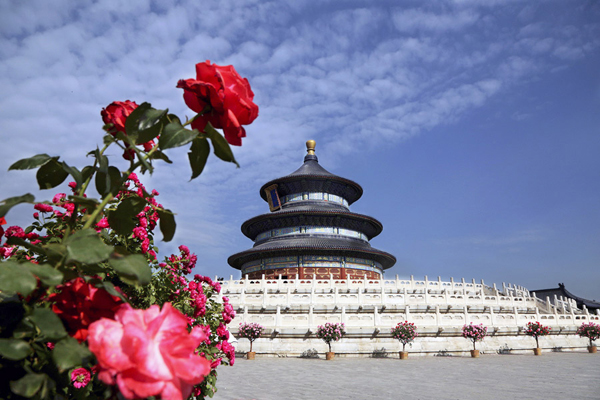
Temple of Heaven
Introduction
The Temple of Heaven, located in the southern part of Beijing, is a spectacular complex of cultural significance, renowned for its stunning architecture set amidst beautiful gardens and ancient pine woods. For more than five centuries, it has stood as one of the most sacred places in China, serving as a crucial site for sacrificial ceremonies conducted by the Ming (1368-1644) and Qing (1644-1911) emperors. The temple complex is the largest among Beijing's royal altars dedicated to Heaven, Earth, the Sun, the Moon, and other deities or symbolic forces of nature, underscoring its paramount importance in religious and cultural practices. The design of the temple encapsulates the symbolic relationship between earth and heaven, reflecting the core of Chinese cosmogony and highlighting the pivotal role of emperors as intermediaries in this celestial connection.
History
The origins of the Temple of Heaven date back to the early 15th century. Initially named the Altar of Heaven and Earth, it was completed in 1420 alongside the Forbidden City during the reign of the Ming Emperor Yongle. In 1530, under Emperor Jiajing, it was decided to offer separate sacrifices to heaven and earth, leading to the construction of the Circular Mound Altar to the south of the main hall specifically for heavenly sacrifices. Consequently, the complex was renamed the Temple of Heaven in 1534. The present arrangement of the temple complex, covering an expansive 273 hectares, was finalized in 1749 after reconstructions by the Qing emperors Qianlong and Guangxu. This historical evolution illustrates the temple's enduring significance and its adaptability to the changing religious practices of successive dynasties.
Architecture
Design
The architectural design of the Temple of Heaven is laden with symbolic meaning and reflects ancient Chinese cosmological beliefs. The complex is arranged axially with the Circular Mound Altar situated in the southern part, open to the sky, and the Imperial Vault of Heaven to its immediate north. These are connected by a sacred, elevated pathway that leads to the Hall of Prayer for Good Harvests further north. This alignment showcases the emperor's role as a mediator between the human and celestial realms. The design is marked by a symbolic representation of heaven and earth, with the southern part of the Inner Temple squared and the northern part semi-circular, echoing the ancient belief that Heaven is round and Earth square. The distinction between the northern and southern walls, with the northern wall being higher, signifies the supremacy of Heaven over Earth.
Layout
The Temple of Heaven's layout is meticulously organized, enhancing its ceremonial function and aesthetic appeal. The complex encompasses a total of 92 ancient buildings containing 600 rooms, making it the most complete imperial sacrificial building complex in China and the largest in the world for offering sacrifices to heaven. The Circular Mound Altar is central to the site, constructed as a three-tiered terrace with rings of stone slabs and steps in multiples of nine, in harmony with the belief that odd numbers, especially nine, are heavenly. The Hall of Prayer for Good Harvests, another focal structure, is a majestic, round building with triple eaves and a cone-shaped blue-tile roof, reflecting the colors of the sky. Inside, the intricate ceiling design featuring nine dragons and the arrangement of 28 wooden columns symbolize various natural and temporal cycles, reinforcing the temple's deep spiritual symbolism.
Significance
Cultural Importance
The Temple of Heaven holds profound cultural significance, embodying the spiritual and philosophical traditions of ancient China. It was the site where emperors conducted solemn rituals to honor the heavens and pray for prosperity and good harvests, reflecting the agrarian society's reliance on favorable celestial conditions. The temple's design and rituals underscore the deep-rooted belief in the harmony between the human and divine, the balance of nature, and the emperor's divine mandate to govern. This cultural legacy has been preserved through centuries, making the Temple of Heaven not only a historical monument but also a living testament to Chinese cosmology and imperial history.
Religious Practices
Religiously, the Temple of Heaven was central to the ceremonial life of the Ming and Qing emperors, who performed the annual winter solstice sacrifice at the Circular Mound Altar to ensure harmony between heaven and earth. The rituals were seen as essential acts of piety and governance, reinforcing the emperor's role as the "Son of Heaven" and the intermediary between the celestial and terrestrial realms. The architectural design of the Temple of Heaven, with its round shapes and celestial symbolism, reflects these religious practices, ensuring that every aspect of the ceremonies was imbued with spiritual significance. The temple continues to be a poignant symbol of China's rich religious heritage, drawing visitors from around the world who seek to understand and appreciate its historical and spiritual legacy.








